Wednesday, May 18, 2016

Some leukus in the making.

Since the last post the snow has melted here in northern Lapland. Seems it happened quite quickly, and now we're having pretty nice weather with just a little bit of some greenish here and there.


Birds start nesting, hares are still half whiteish, everything needs to hurry towards the summer. Nights don't get really dark anymore, the very northest part of the Lapland bit further away from here has reached the time of midnight sun already.

Last few days I've been working on a small set of leukus. Here's a random look at the work with some pictures:


Blades were forged out of a flat bar of 80CrV2 tool steel. No forging pics this time, if you're interested there's some in this Nordiskaknivar blog post from 2013.

When blades are ready it's time to fit brass front bolster plates. All the work is done with a dordless drill and needle rasps.

Then curly birch blocks are cut from with a hand saw.


Ends are levelled on belt sander. Lines for the tang are drawn on.


Using the drill again. Several holes from both ends, then using the same drill as a kind of a mill to enlarge the hole.
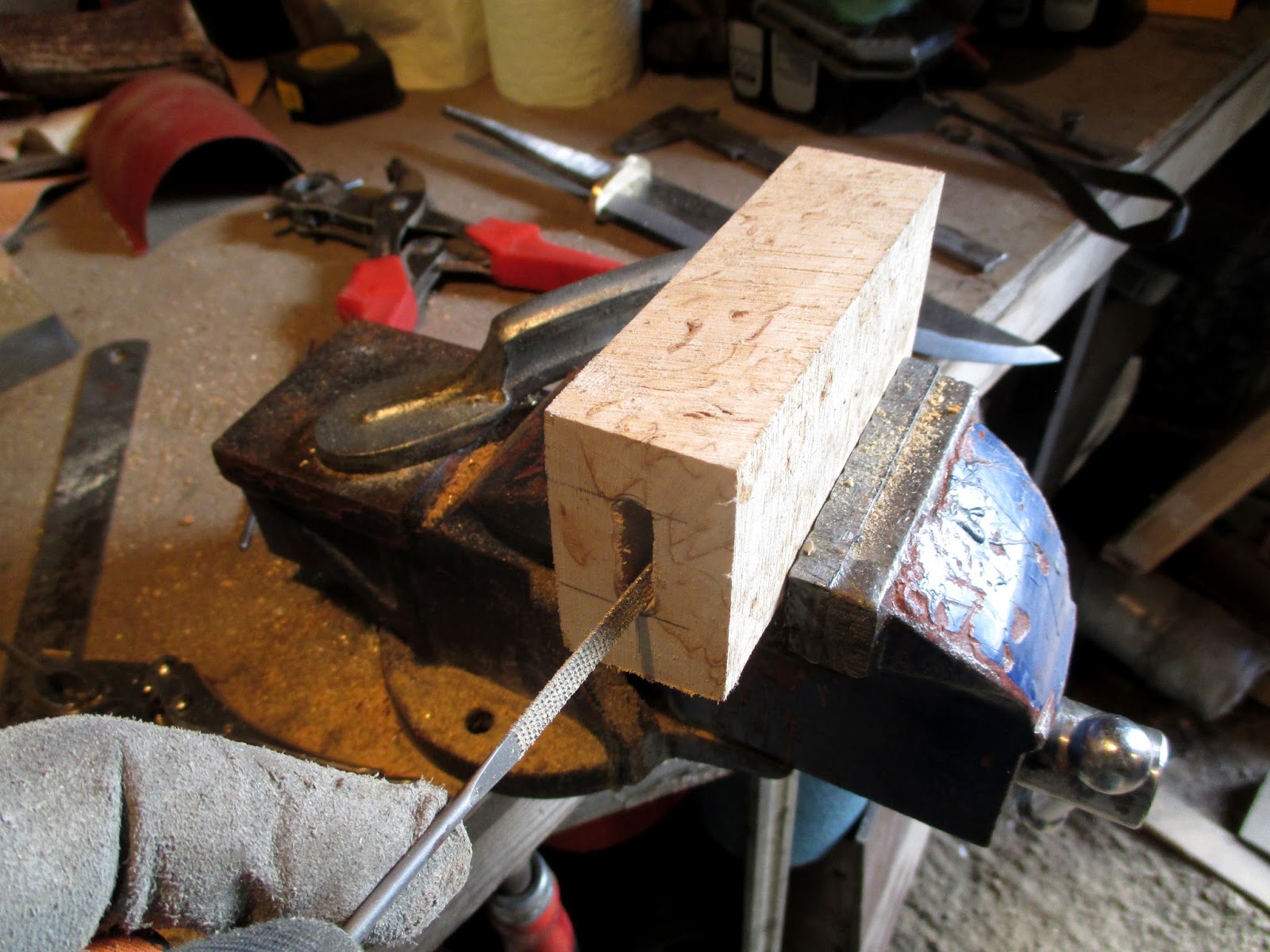


Final fitting is done with needle rasps.


After the curly birch blog fits snugly on the tang it't time to fit the butt bolster plate. Thin spacers of reindeer hide between the brass and wood.


Handle parts fitted, ready to be glued with epoxy


Tang is peened on the butt plate when the glue is still open. Handle is slightly sanded to see that all parts fit properly. Now the glue is left to set for a day.


Next day starts with shaping the handles roughly on a belt sander.


Then moving to hand sanding.


Screws are attached to reinforce the pommel. Heads are sanded down. Final sanding on the handle is done.


Handles ready, now it's time to make the wooden liner for the sheaths....


Blade shape is drawn on a strip of birch. Cut out with a knife and chisel.


Backs of the liners are made of birch plywood. Then glued together, and the liner is shaped.

When liners are finished, it's time for the leukus to take an oil bath.

Next day is a sewing day! Cow hide is cut, mouth part of the sheath slightly thinned, and then folded.

Knife is wrapped in plastic foil, liner put on the blade, then the wet leather is sewn over the whole package.

After they're dry, sheaths are trimmed, dyed, and treated with leather cream. Then the final polishing on the knife itself, and should be good to go!

These leukus should be ready by tomorrow evening. They'll be up for sale then, so if you're interested in one, stay tuned!


Wednesday, April 20, 2016

Two puukkos for sale! (Sold!)

Basic Finnish style knives. Oiled curly birch handles, 80CrV2 carbon steel blades. My regular brown leather sheath included.


Number 1: 94x22mm rhombic cross section blade, thickness 4,9mm at the shoulders, tapering towards the tip. 110mm long handle, width 30mm and thickness 23mm at max.

SOLD!


 Number 2: 100x22mm rhombic cross section blade, thickness 4,8mm at the shoulders, tapering towards the tip. 111mm long handle, width 30,5mm and thickness 23mm at max.

 Sold!


Tuesday, April 19, 2016

A week on the skis.

With a friend of mine we had planned a skiing trip for last week. Quite perfect timing, as when he arrived it was raining and temperatures had been above zero for some days. The day we started skiing temps were dropping below zero and no sign of rain anymore. Stayed below zero the whole week, and when he left it started raining again.


 We had a pulk and backpack. A pulk takes easily quite heavy load, so backpack could be left much lighter. In wintertime it's good to have warm extra clothing plus some other stuff you don't need on summer or autumn trips. We were planning to do ice fishing too, so had an auger as well.

Maybe even 80cm of snow here still, so winter is not over yet!

In winter it's easier to travel accross the flat marsh areas. Plus you get to places you would most likely avoid in summer.

Skiis are the way to go here. You can see people on snowshoes, but usually only on shorter trips. Common Finnish forest skis are way over 2 meters. Up here where you can avoid thick forests if you want, even 3 meter long skis are used. Our skis were 2,6 and 2,7 meters long.


We spent the first night in an open wilderness hut. Original plan was to ski bit further right on the first day, but due to the warm weather before the trip snow was pretty soft still. We decided to call it a day bit earlier, and continue tomorrow.


Next night temperature dropped below zero, so it was much better to ski right away.

Having a break by the fire is much more relaxing than just quicly having a snack while skiing.


One of the typical views on the trip were dense birch forest along the rivers and creeks.


Mostly we skied along the open areas. No traffic here.


We set our camp always in tall forest, as it provides better firewood.

At this spot under the trees ground was almost exposed, so it was easier to dig rest of the snow away to set up the shelter.


We set a tarp above the fire as well. In the case of nuclear fallout, or something.....


Drying socks and boot liners, melting snow in a pot, typical activities in winter camping. Warm evening, so no big fire needed.


Late evening in the middle of nowhere. Or somewhere. One form of freedom!


Ice fishing on a silent lake. Thickness of the ice was probably around 70-80cm.


It's hard work as you can see! We were not lucky at this lake, so it was easy to fall a sleep on the sun.


Crossing creeks and small rivers was easy. Especially on long skis, as they divide the weight on larger area. Only some openings here and there.


Did I mention earlier that breaks by the fire are relaxing? Well, not this time! A windy day, so we set the tarp to protect from the wind. Of course it was blowing from here and there, which made the smoke swirl around. We left the place feeling like smoked skiers.


Willow grouses have a decent camouflage in winter conditions. There's one almost in the center of the picture. Sometimes in early winter all the snow might melt away, leaving already white willow grouses shining like white balls on dark ground for some days. In summer they're brownish, only the wings being white.


After the nights had been bit colder we could set the shelter just on the snow. Ergonomic seating by the fire and nicely flat surface under the mattress.

When night temps dropped below -10 celcius you could easily even walk on the snow. Making it much more easier to work and gather firewood around the camp.


Collecting and chopping dried roots of fallen pines for the firewood. Good source of fatwood. Fairly good source for a thick layer of sooth on the pot as well.... Soon your fingers are black, then face... but who cares, it's not a beauty contest.


Taking turns in pulling the pulk. Glides very effortlessly on hard snow. Only downhills can be tricky, as the pulk is pushing you. Easier to zig zag when going down.


Ice fishing on a sunny day.

Almost at the end of our trip. Same hut where we spent the first night.


A pair of old skis on wall of one of the cabin in the area. Curved tip has straightened during the years. Would be nice to know what kind of history they have behind.


Open wilderness huts always have a guestbook. Interesting to read the notes to see how often there are visitors, what nationalities, and so on.
Heading back home. Tall forest, marsh, lake, fellside... no matter as long as it's untouched wilderness it's always good!