On my trips to the woods I always carry a small axe / hatchet with me. I've found out that for me max. 1kg axe is fairly enough. I rather pack a saw too than take a bigger axe. My current user hatchet is the first one I made, about 14 years ago, so I thought I'd make a new one for myself.
This axe head starts it's life as a piece of truck leaf spring. Cut off with an angle grinder and then annealed.
Then I drill a pivot hole for the eye drift. This is not necessary of course, but helps when punching the eye. Especially when working alone, and without power hammer or press.
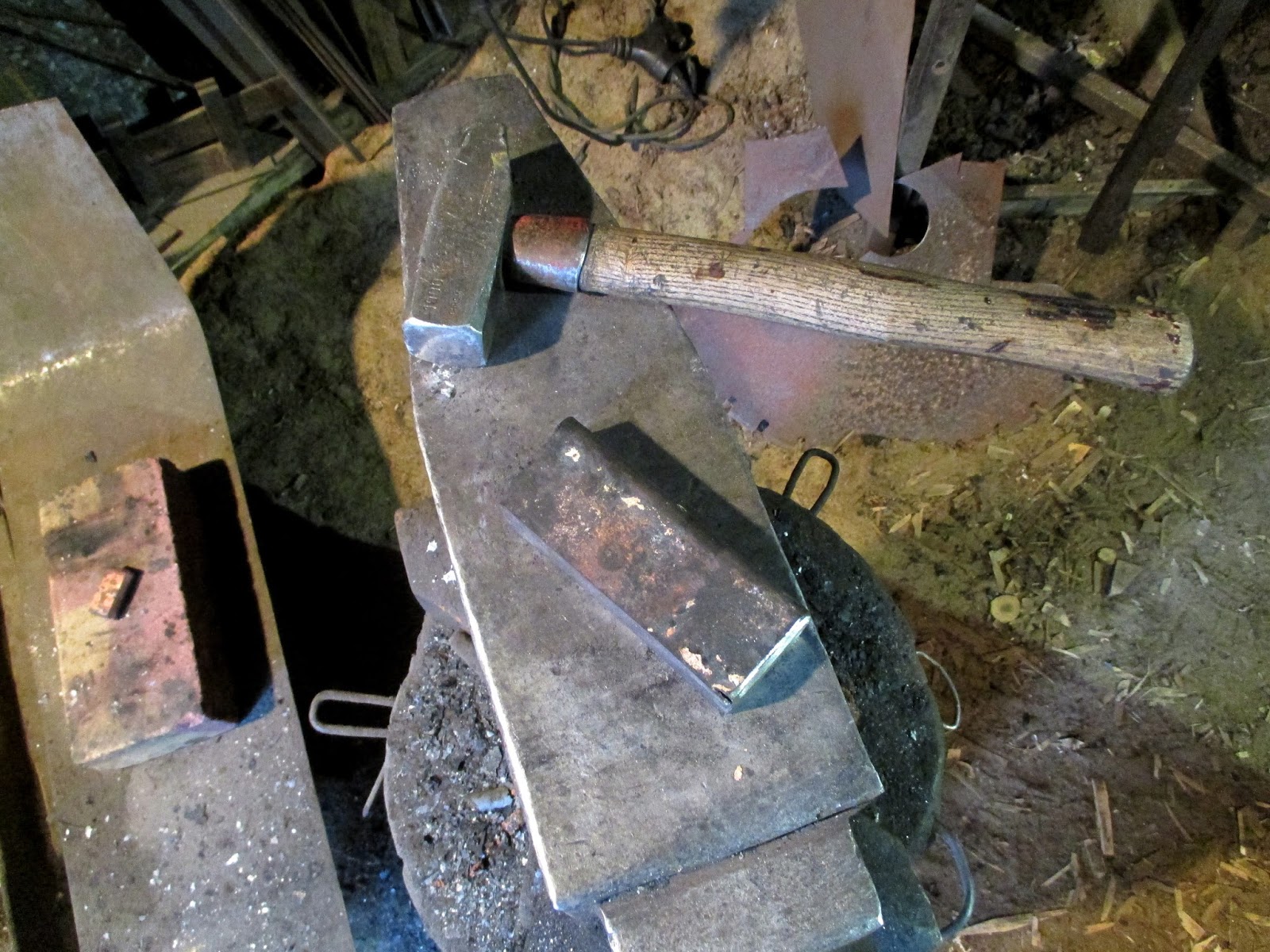
Punching the eye. Takes many heats to get it done.
Eye done.
Starting to form the blade, for this I wanted some beard, and a bit of thinning behind the bevel to reduce weight.
Blade bit and poll are forged in shape.
Corners filed down and shape finished, edge sanded ready for heat treatment.
Edge is hardened in oil, then immediately tempered on glowing coal of the forge. When tempering is finished the whole head is dipped in tar and excess is wiped off.
Then it's time to start with the handle. Shape is drawn and cut off with a jigsaw. This time I used white ash. I still have some planks left from the time I used to make bows. Good material for tool handles.
Rest of the handle work is done with rasp, file, and sandpaper. First the eye part is fitted, leaving last half a centimeter to be hammered in when finally fixing the head.
I like to use cross wedges, so next thing was to saw two slots for them, and whittle the wedges from juniper. Before the handle is finally fixed I sanded the edge of the bit, and finished the handle with coarse sandpaper.
Then just fitted the handle in it's place, hammered wedges in with some wood glue, and let it dry. Next day it got some boiled linseed oil for protection, as well for the head itself.
This axe came out weighing about 800 grams, with a total lenght of 40cm. Edge is about 7cm. Decent size for my needs.

Most often around the area where I live I use stumps and roots of a fallen pine for campfire. From these you can pretty easily find fatwood, which lights up easily even in the rain. Downside with them is that they can have some rocks between the roots, so you easily damage the edge of your axe even when being careful. Stumps with roots won't always split easily, so I like my axe handle to be relatively thick, especially on the neck, so I can sometimes bend it bit sideways too. On the other hand it can't be too thick for grabbing it just below the head still.
Edge needs to be aligned straight with the handle. Decent end knob is a must in a wilderness axe, as you sometimes work with wet hands and tired.
I'm not that strict with bevel/edge geometry of my outdoor axe. Usually I use flat bevel with a secondary, convex works too. This is not a carving axe, so splitting properties are more important than being able to carve nicely.
I'm not a fan of sharp or pointed lower corner/heel of the bit, so bearded design gives more obtuse corned without adding weight. Also a flat poll is important for me, for example to drive tent stakes to the ground.
Future will show if this axe is to my liking in the woods.




 Most often around the area where I live I use stumps and roots of a fallen pine for campfire. From these you can pretty easily find fatwood, which lights up easily even in the rain. Downside with them is that they can have some rocks between the roots, so you easily damage the edge of your axe even when being careful. Stumps with roots won't always split easily, so I like my axe handle to be relatively thick, especially on the neck, so I can sometimes bend it bit sideways too. On the other hand it can't be too thick for grabbing it just below the head still.


