Sunday, June 7, 2015

Forging a hatchet.

On my trips to the woods I always carry a small axe / hatchet with me. I've found out that for me max. 1kg axe is fairly enough. I rather pack a saw too than take a bigger axe. My current user hatchet is the first one I made, about 14 years ago, so I thought I'd make a new one for myself.

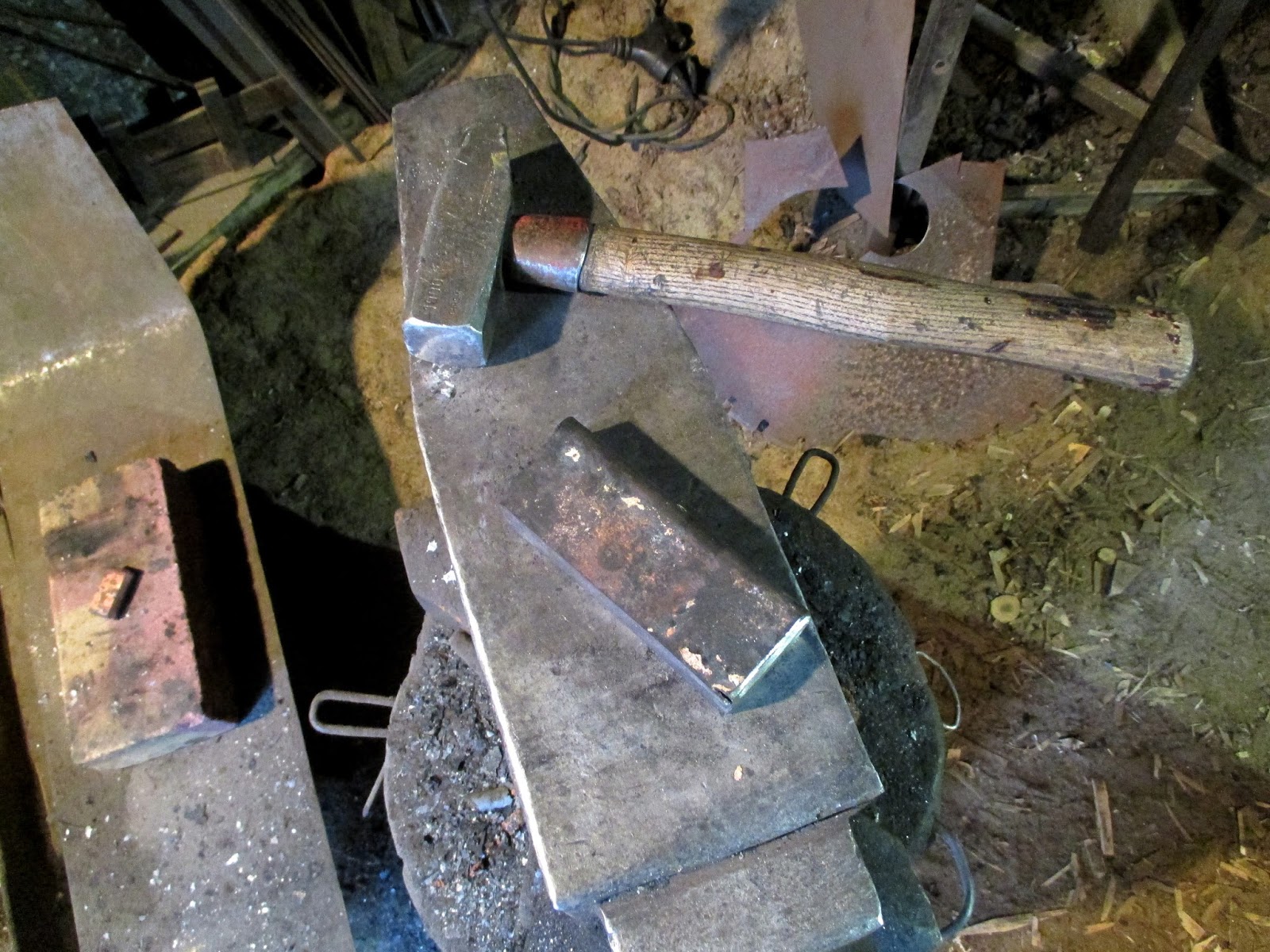
This axe head starts it's life as a piece of truck leaf spring. Cut off with an angle grinder and then annealed.

Then I drill a pivot hole for the eye drift. This is not necessary of course, but helps when punching the eye. Especially when working alone, and without power hammer or press.

Punching the eye. Takes many heats to get it done.


Eye done.


Starting to form the blade, for this I wanted some beard, and a bit of thinning behind the bevel to reduce weight.


Blade bit and poll are forged in shape.


Corners filed down and shape finished, edge sanded ready for heat treatment.

Edge is hardened in oil, then immediately tempered on glowing coal of the forge. When tempering is finished the whole head is dipped in tar and excess is wiped off.

Then it's time to start with the handle. Shape is drawn and cut off with a jigsaw. This time I used white ash. I still have some planks left from the time I used to make bows. Good material for tool handles.

Rest of the handle work is done with rasp, file, and sandpaper. First the eye part is fitted, leaving last half a centimeter to be hammered in when finally fixing the head.

I like to use cross wedges, so next thing was to saw two slots for them, and whittle the wedges from juniper. Before the handle is finally fixed I sanded the edge of the bit, and finished the handle with coarse sandpaper.


Then just fitted the handle in it's place, hammered wedges in with some wood glue, and let it dry. Next day it got some boiled linseed oil for protection, as well for the head itself.

This axe came out weighing about 800 grams, with a total lenght of 40cm. Edge is about 7cm. Decent size for my needs.


Most often around the area where I live I use stumps and roots of a fallen pine for campfire. From these you can pretty easily find fatwood, which lights up easily even in the rain. Downside with them is that they can have some rocks between the roots, so you easily damage the edge of your axe even when being careful. Stumps with roots won't always split easily, so I like my axe handle to be relatively thick, especially on the neck, so I can sometimes bend it bit sideways too. On the other hand it can't be too thick for grabbing it just below the head still.
Edge needs to be aligned straight with the handle. Decent end knob is a must in a wilderness axe, as you sometimes work with wet hands and tired.


I'm not that strict with bevel/edge geometry of my outdoor axe. Usually I use flat bevel with a secondary, convex works too. This is not a carving axe, so splitting properties are more important than being able to carve nicely.

I'm not a fan of sharp or pointed lower corner/heel of the bit, so bearded design gives more obtuse corned without adding weight. Also a flat poll is important for me, for example to drive tent stakes to the ground.

Future will show if this axe is to my liking in the woods.


Monday, June 1, 2015

Late spring hike


On the last week of May we went for a hike in Hammastunturi wilderness area. In southern Finland it can be already summer temps, but up here it's usually time for spring floods and last spots of snow melting away. Not really leaf buds yet, but night temperatures have been above zero for a while now. Nice time for hiking, as there's no mosquitoes yet.

This time of the year dogs have to be leashed in the woods. Nesting time for birds and other animals is about to start.

Just after 1 km on marked trail there's several old buildings from a gold digging era at the area. Part of the cabin serves as an open wilderness hut. These surroundings are still quite active in gold panning. Mostly as a hobby, but there are several people who even get a living out of it.

Suspension bridge over river Sotajoki.

Last winter's snow load has been too much for many young trees. Plenty of them around this area.

 Still some snow left, especially on north side of the hills and fells.

You can see the age difference when having a break. Teenager is constantly sniffing around, but a 10-year old rather enjoys the view.

 Reaching the Ivalojoki valley.

Suspension bridge over Ivalojoki. Main buildings of the golden history of the river are on the other side.

Looks like the dogs are watching if my girlfriend will also make it to the other side by that annoying wobbly bridge.

Main building of Kultala, "the golden place". It served as a Crown Station, house for state officers etc. Built in 1870. It's open for public. On the left is a bakery.


                                                 Some interior pics of the main building.


Front side of the bakery. This is rebuilt after the pictures of the original one.

 Inside of the bakery.

 Where there's a log wall, there's a need to carve your name on it..... I didn't.

 Open wilderness hut near the main building.

 Dogs are enjoying something that doesn't happen at home... Sitting on the bench during the breakfast.

 Nice weather to spend morning by walking around the riversides.

Some fishing too.


Creations of the ice age. Hiidenkirnu in Finnish.

Taking a look back to Ivalojoki, when walking back towards the starting point.
                                        
For first kilometers on the way back Pyry was hesitating to continue. Just slowing down turning back, and showing that he would like to continue the other way, not back to the car. Obviously too short trip.


                   But after a while he was his old self. Rolling in the snow to cool down, disappointment  
                   was obviously left behind.


Saturday, May 30, 2015

Knife for sale (SOLD)

This time for sale is a Lappish type knife. Carbon steel blade in scandi grind with a small secondary. Handle materials are brass, moose antler and birch bark, with thin reindeer hide next to antler spacers. Tang peened on an inlaid brass plate. Dark brown leather sheath with a birch wood full liner inside for the blade.

- Blade 97x21x4,8mm
- Handle 113,5mm long, 31x22mm max width and thickness, 35,5x24 pommel.
- Weight knife only 135 grams.

This knife is sold, thank you!


Friday, May 22, 2015

Puukko + Leuku

These are my typical works as a maker of Nordic knives. A puukko with 9,5cm carbon steel blade and birch bark + brass handle. Larger knife is a Lappish style leuku, this time with about 22cm blade. In top picture tar oiled curly birch/brass handle, in lower with dyed curly birch/moose antler/ brass.  All my knives have individually made belt carry sheath, with birch wood liner inside to cover the blade.


In leukus a full flared relatively large pommel plays a big role. As a large knife it's meant to be used also in chopping tasks, and this type of pommel prevents the knife from sliding out of the hand even when your grip ain't that tight. It also makes it possible to wield the leuku just by holding it from the pommel. This is important with a bit shorter bladed leukus, to give more leverage for chopping.

In areas where leukus are from, the winter and cold period of the year is very long. So quite often you wear gloves, even very thick ones, so obviously a knife with flared full pommell is much easier to unsheath.

I prefer to make leuku blades few millimeters less in width than the handle, so the knife can be sheathed/unsheathed without compressing the sheath mouth.I find that feature more important than the extra weight near the tip given by the blade widening drastically. This is very common with many leukus, but as well it's quite common to see leukus which have a wider blade and you have to press the mouth of the sheath flat when pulling the knife out. If you want more weight at the front, then I rather forge the blade getting bit thicker towards the tip.

Basic barrel shaped puukko is an all-rounder, very common style in Finnish knife culture. Puukkos with some kind of a pommel are common too, but I would say this barrel shape is the most common in historical point of view. Birch bark provides good grip even when wet, which helps not only in use but also when unsheathing the puukko.

Friday, May 15, 2015

Is the summer coming or not?

It's May. A month of almost hot sunny days, but as well chilly snowing every now and then. Just yesterday it was very warm and summerlike weather. And today around 0 celcius, wet snowing, gray, chilly wind like in October.

Almost all of the snow has melted, but lakes are still mostly covered with ice.


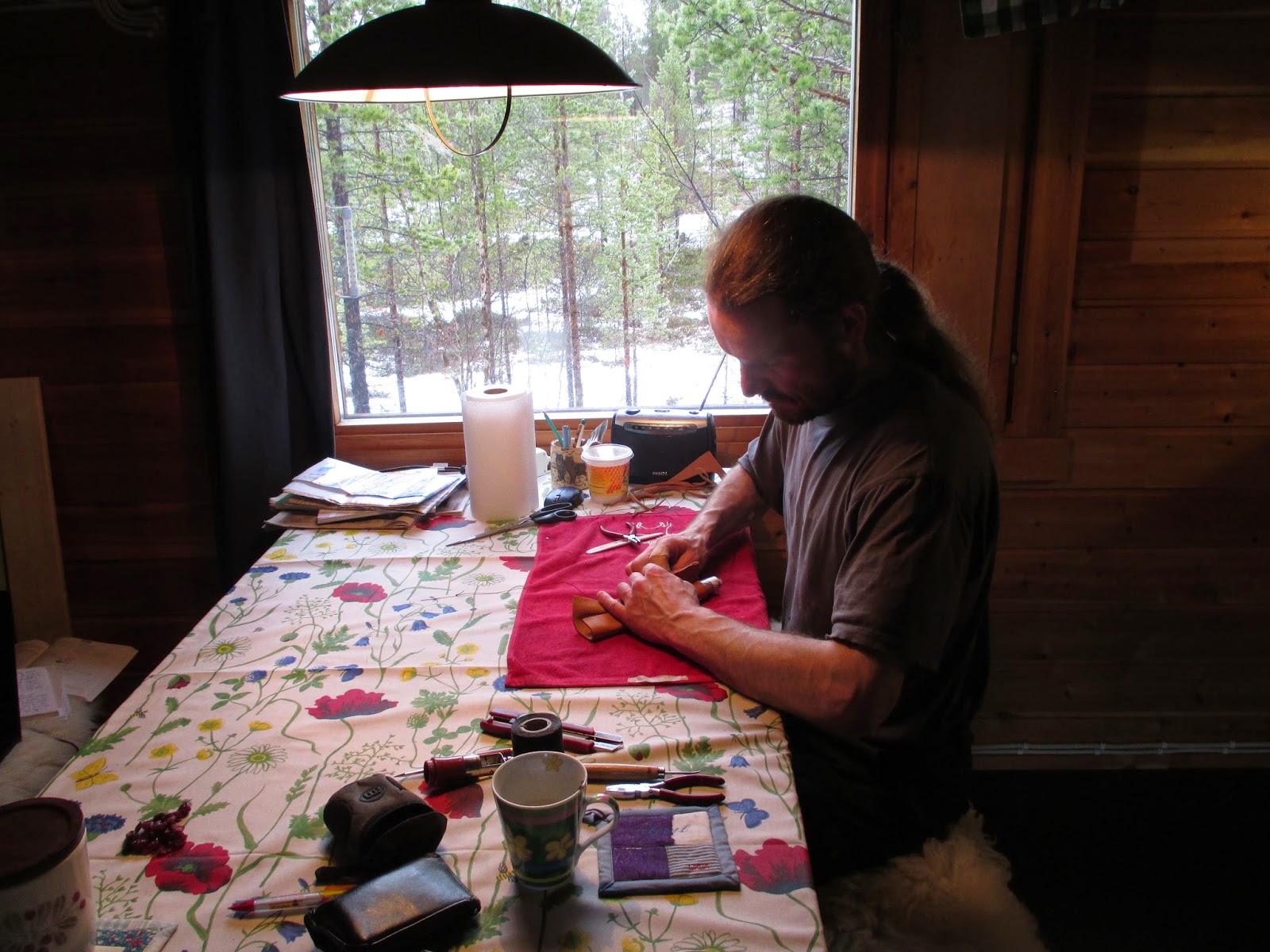
Today I spent most of the day inside. Sewing knife sheaths and watching the rain and snow taking turns. Walked only 2 hours in the forest. Yesterday I saw a first mosquito of the year. No sign of them today in cold weather. I don't miss them, but many birds would find some use for them I'm sure.


A female capercaillie came right in front of the window, looking like just about to ask if there's some food to offer. Hopefully early summer won't be cold and wet like the weather now, as it would mean hard times for nesting.


In the east wing of my company's knife manufacturing facility is the ultra modern professional sheath drying laboratory; the sauna.


Sheaths stithched, left to dry, waiting for tomorrow's dyeing. Now it's good time to bring back some memories from last week's skiing trip in northern parts of Inari municipality. Pretty perfect weather, some skiing, ice fishing, skiing, ice fishing... not bad at all!

My friend hauled his stuff in a pulk...
...and I had a packback, as usually. Not much difference in effeciency, as the snow didn't get really soft at all even during the daytime.


Graylings were a common catch. Some to eat in the evening, and something to take back home too.


It was a last trip on the skis for this season. Even in these northern parts pretty good amount of ground was exposed already. Not really slowing down yet though. But now a week later with raining and temps constantly above 0 it's a different story already there too. Will be on foot and paddling the canoe for the next 6 months. Now waiting for lakes to open for setting fishing nets and getting some fish to table again.